Video Ad Hooks (2026): Stop the Scroll in 3 Seconds, Sell in 7
Video ad hooks decide whether anyone watches. Learn seven hook types, how to plan what viewers see, read and hear, and what the next 7 seconds should do.
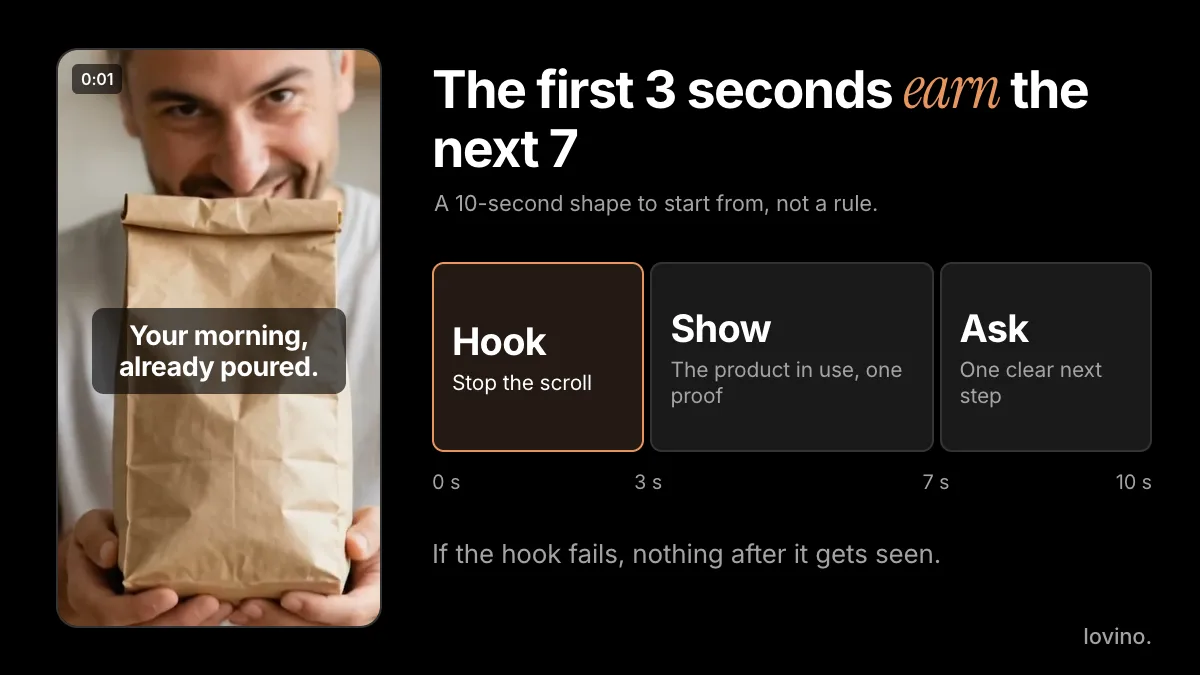
Video ad hooks are the first one to three seconds of an ad, and they have one job: earn the next few seconds. Put something moving in the first frame, say what the viewer gets in a handful of words, and keep the product on screen. Then use the next seven seconds to show it working and ask for one thing. Most weak ads do not fail at the offer. They fail before anyone gets there.
There is a hard reason to be quick. On YouTube, Google's help page says viewers can skip a skippable in-stream ad after 5 seconds. TikTok, Reels and Shorts let people swipe away at any moment. The clock is the same.
What is a video ad hook?
A hook is not a trick. It is the first promise your ad makes, built from three parts that arrive together:
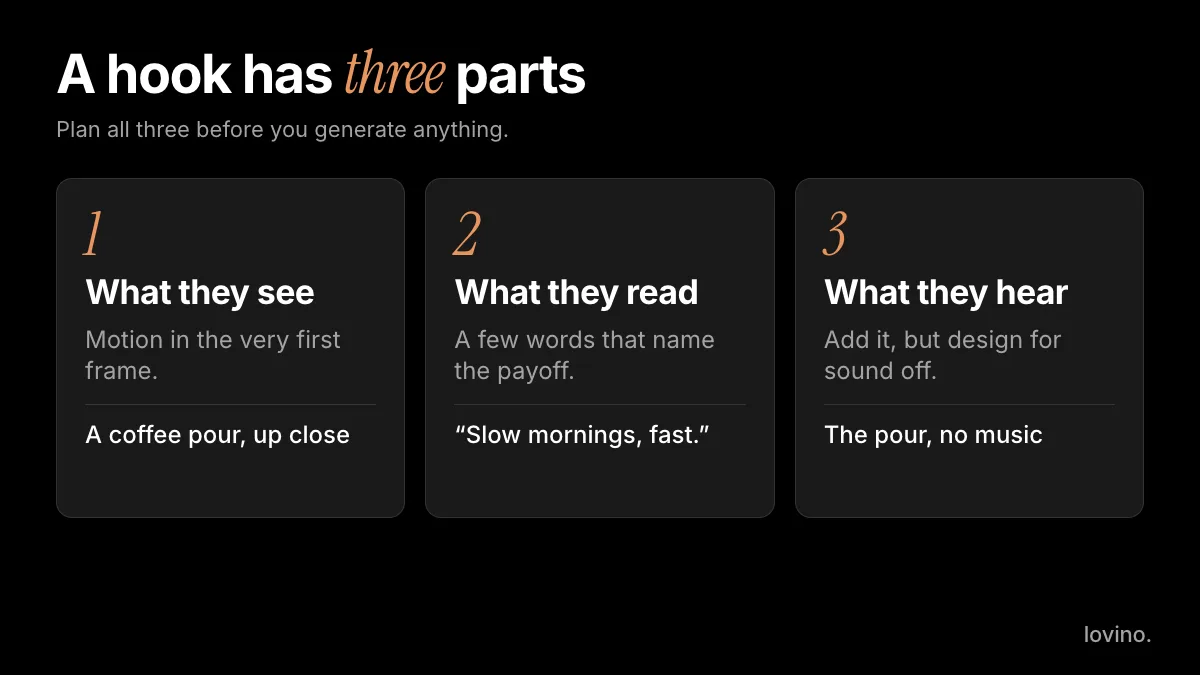
If any one part is missing, the others work harder. If the promise is not paid off by the rest of the ad, the hook was bait, and viewers leave anyway.
What are the best video ad hook types?
These seven cover most products. Pick one per version, then keep the rest of the ad identical so you can learn from it.
| Hook type | First 3 seconds | Works best for | Keep it honest |
|---|---|---|---|
| Result first | Open on the finished outcome | Anything with a visible result | Show a real result |
| Problem | Name the annoyance and show it | Everyday fixes | Do not exaggerate the problem |
| Demo | The product in motion from frame one | Tools, gadgets, food | Show only what it really does |
| Pattern interrupt | An unusual close-up or angle | Crowded categories | The picture must connect to the product |
| Question | An on-screen question about their situation | Niche audiences | Ask something real, not fake urgency |
| Reveal | A box, lid or cover opens | Gifts, launches | Reveal the real item |
| Proof | A real quote or a real number | Established products | Only quotes and numbers you can show |
Sensory hooks sit under pattern interrupt. A coffee pour is a good example, because the motion is the message. This clip was made with Seedance 2.5 on Lovino.
Here is one on-screen line per type, for an imaginary coffee brand:
Result first       Your morning, already poured.
Problem            Still waiting on the kettle?
Demo               Watch the first pour.
Pattern interrupt  (no words, only the pour, close-up)
Question           What does fresh actually smell like?
Reveal             Open the bag.
Proof              Roasted this week.   (only if it is true)
Notice that none of them promises a health benefit or a number. That is deliberate. The safest hooks promise what the picture can really show.
How do you plan the first 3 seconds?
Plan the hook before you generate anything. Five steps:
- Write the payoff in one line. What does the viewer get? "Slow mornings, fast."
- Choose the first frame. The product in motion, in a hand, or at the moment of the reveal. Close shots read better on a phone.
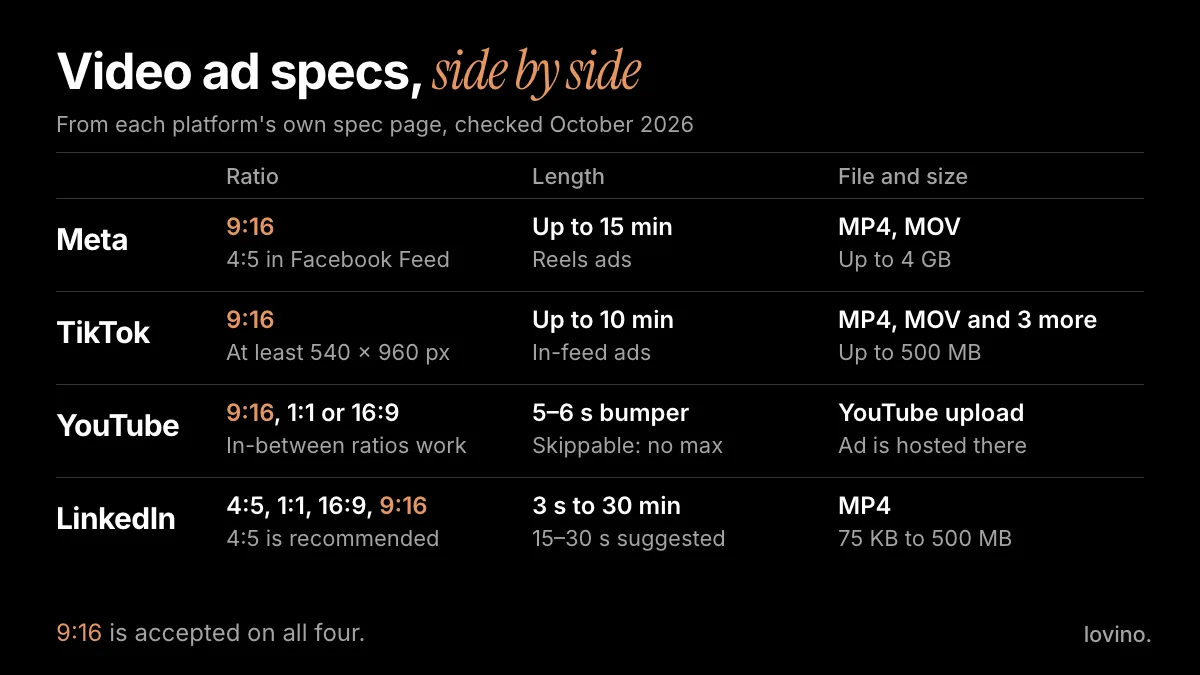
- Add three to six words on screen. They should make sense in a glance, and sit inside the safe zone so the interface does not cover them. The video ad specs post shows the numbers.
- Decide the sound. Add it, but design for sound off. Meta marks captions and sound as optional but recommended, and strongly recommends sound for Reels ads.
- Cut everything before the hook. No logo sting, no slow intro, no "Hi, I'm..." unless that line is the hook.

Here is a reveal hook in creator style for the same imaginary coffee brand. An AI-made presenter holds a plain kraft bag to the camera and grins from behind it. The product is on screen from the very first frame, so "what they see" is settled before anyone says a word. The loop comes from a five-second clip animated from a single AI-made still with Wan 2.2 Fast, one of the image-to-video models on Lovino.
What should the next 7 seconds do?
Treat them as two jobs. Show the product working, then ask for one thing.

Here is a 10-second shape for the same imaginary coffee brand. It is a starting point, not a rule:
| Seconds | On screen | Words |
|---|---|---|
| 0 to 3 | Milk hits espresso, close-up | "Slow mornings, fast." |
| 3 to 5 | A hand lifts the cup, the bag stands behind it | Nothing, or the roast name |
| 5 to 7 | One real proof, such as the roast date printed on the bag | The real date |
| 7 to 10 | The bag, centred | "Order today's roast." |
Keep to one proof and one ask. An ad that tries to give three reasons and two buttons gives the viewer a reason to leave.
How do you make video ad hooks with AI?
Build backwards from the first frame.
- Make the hook frame as a still. Generate the picture that will open the ad, in 9:16, with room for words. The image generator is the quick way to get it right.
- Animate that still. Image-to-video starts from your pixels, so the opening frame is exactly the one you chose. Here is a motion prompt for the coffee shot:
Close-up of milk pouring into a glass cup of espresso, slow motion.
Steady camera, soft window light, steam rising. No cuts.
- Choose a model. Seedance 2.5 builds realistic scenes from text, with optional native sound, but it does not take a person's face as a start photo. For a face-led frame like the coffee-bag one above, use an image-to-video model that does, such as Wan 2.2 Fast. Veo 3.1 Fast adds optional audio. Seedance 2.5 and Veo 3.1 Fast need a paid plan, and every video uses paid credits. See pricing.
- Keep test clips short. Five seconds is enough to judge a hook. Make longer versions only for the ones that work.
- Write the on-screen line separately. A prompt you can paste into an AI chat assistant:
Give me ten on-screen hook lines for a 6-second coffee ad, six words or fewer each.
Mix questions, results and objections. No health claims and no numbers.
In Ad Studio, some recipes build the hook into the angle. Problem, Meet Solution opens on the pain, and Unboxing Reveal builds anticipation for the reveal. The copy is a draft, so read every line.
For more wording, see the ultimate guide to AI video prompts.
What should you never fake in a hook?
Hooks are where ads are most tempted to stretch the truth. Do not:
- Invent a result. No before-and-after that never happened.
- Fake a reaction. An AI-made person gasping at a product is a claim about customers.
- Use made-up urgency or numbers. "Only 3 left" has to be true.
- Change the product. The clip must show the item customers get. Watch the full video for a label or cap that drifts.
- Mislead about what the ad is. If the first frame suggests a news story or a message from a friend, you are borrowing trust you did not earn.
Some places also require AI labels on ads. See AI content disclosure.
How do you test which hook works?
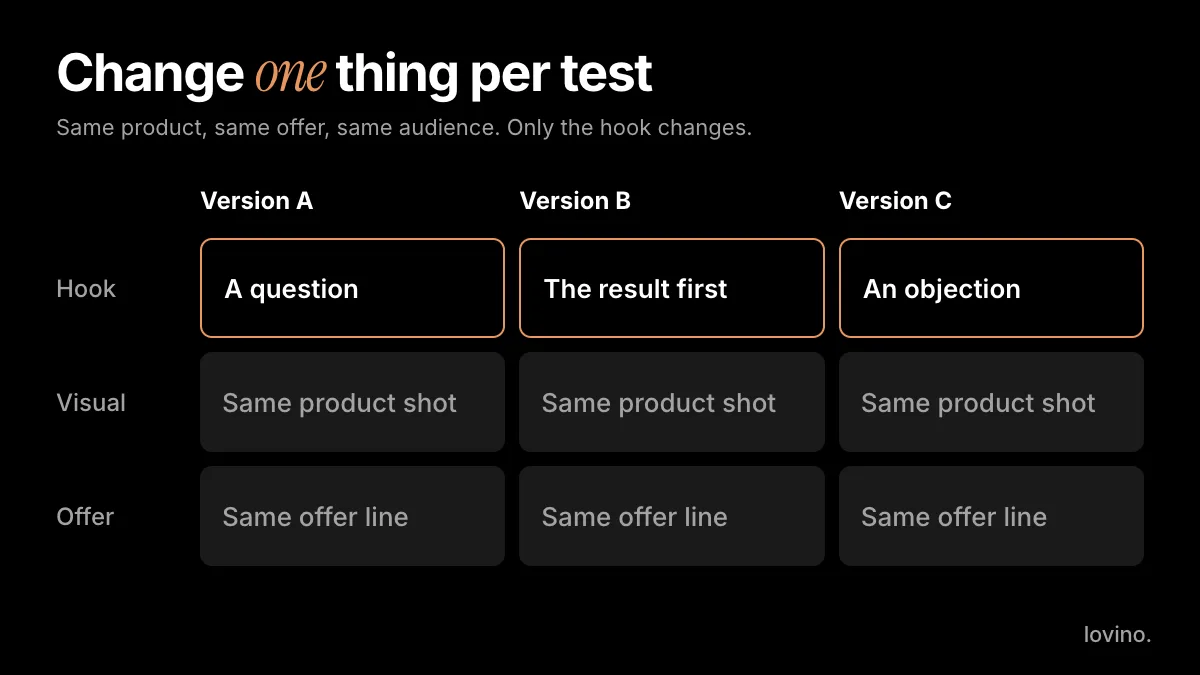
Make three hooks on one identical body. Same product, same offer, same ending. Launch them with equal budgets and wait before you choose. The creative testing method covers the full setup. If you are not sure whether the idea should be a clip or an image, see static vs video ads.
Start with one frame
Write one payoff line. Make one hook frame. Animate it for five seconds and judge it with sound off. Then build the other six seconds around what works. For organic Reels rather than paid ads, see Reel hook ideas.
To start, open the image to video tool with your hook frame and write a one-line motion prompt.
Questions, answered.
What is a hook in a video ad?
The first one to three seconds of the ad. It combines what viewers see, what they read on screen and what they hear, and its job is to earn the next few seconds. A good hook is paid off by the rest of the ad.
How long should a video ad hook be?
About one to three seconds, though there is no fixed rule. On skippable YouTube in-stream ads, Google says viewers can skip after 5 seconds, so the main point should land before then. On feeds, the same logic applies to scrolling.
Should video ads have sound?
Add sound, but design the ad to work without it. Meta lists captions and sound as optional but recommended on most video placements, and says sound is strongly recommended for Reels ads. Put the point in the picture and the on-screen words first.
Can AI make video ad hooks?
Yes. AI can write hook lines, generate the first-frame still and animate it into a short clip. You decide what to run and check every claim. On Lovino, the video models mentioned here need a paid plan, and the credit cost is on the pricing page.