Ad Creative Testing With AI: A One-Variable Method (2026)
Ad creative testing gets easier to start and easier to get wrong when AI makes ads cheap. Here is a one-variable method, what to measure, and when to stop.
Ad creative testing works when you change one thing per round, give every version the same budget, and pick your success metric before launch. AI makes the first part easy, because ad variants now take minutes. That is also the danger. When variants are cheap, people launch twenty of them, change five things at once, and learn nothing.
Below is a method that keeps the speed useful. It will not promise you a winning ad. It will make sure that whatever wins, you know why, and the numbers that decide it are your own.
Why does cheap creative make testing harder?
Because the bottleneck moves. When each ad took a day to produce, the cost forced you to think before you made it. Now nothing does.
Two traps follow:
- Too many ads. Meta's help page on the learning phase says that creating many ads and ad sets means the delivery system learns less about each one. It recommends fewer ads and combining similar ad sets. A small budget spread across a dozen variants gives you a dozen unreadable results.
- Too many changes. If version A has a new hook, a new scene and a new offer, and it wins, you do not know why. You cannot repeat it.
AI should widen the set of ideas you consider. It should not widen the set you launch.
What can you test in an ad?
Treat every ad as a stack of separate choices. Change one layer per round.
| Variable | Example change | How to make it with AI |
|---|---|---|
| Hook | A question versus the result first | Rewrite the first line and the first frame, keep the rest |
| Scene | Flatlay versus studio podium | Pick a different Ad Studio recipe for the same product photo, then match the copy (see below) |
| Format | Static image versus a 6-second clip | Turn the winning image into a video |
| Offer line | Bundle versus free delivery | Edit the copy by hand, and only with an offer you really run |
| Call to action | "Shop now" versus "See how it works" | Edit the button text |
| Length | 6 seconds versus 15 seconds | Generate a second clip length |
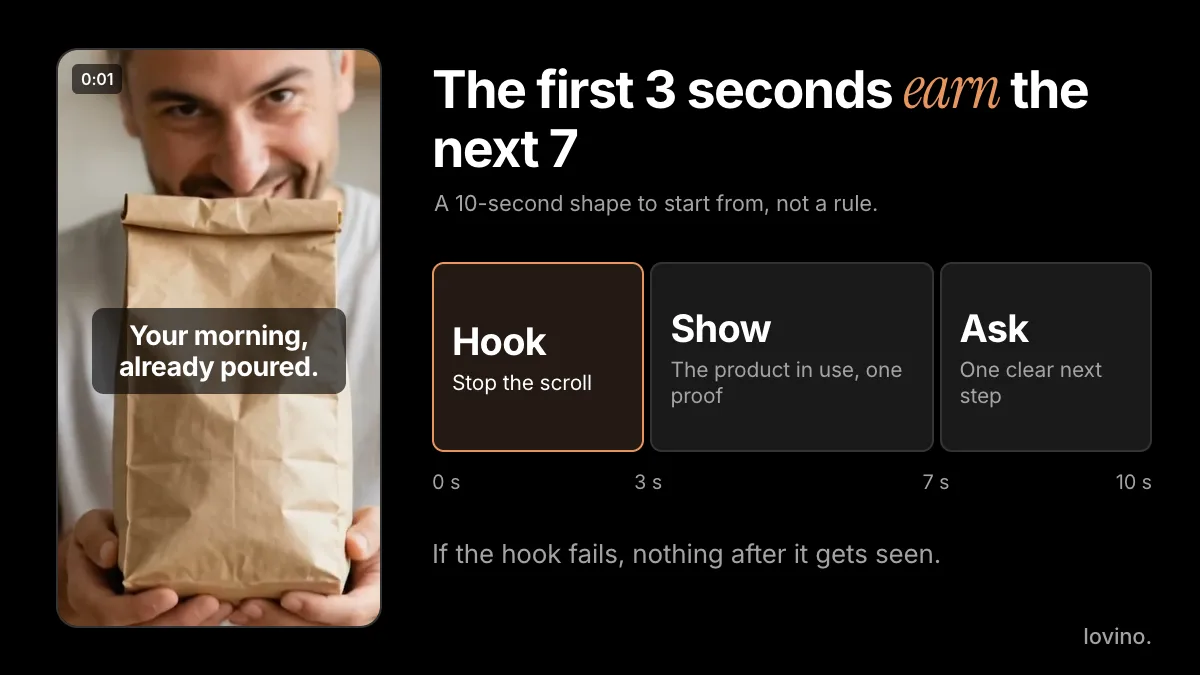
Start at the top of the table. The hook and the first frame decide who keeps watching, so they decide whether anything else gets seen. Offer and call to action come after.
How do you structure ad creative testing, step by step?

- Write a hypothesis. Meta's A/B testing guide says to choose one before you pick a variable. For example: "A question hook will stop more people than a result-first hook for this serum."
- Choose one metric. Pick the number that matches the goal of the ad. Do not decide after you have seen the results.
- Make two to four versions. Three is plenty. Keep everything except the tested layer identical.
- Name every version. Future you will not remember which was which.
- Launch together with equal budgets. Meta recommends the same budget for each version, and advises against informal testing by turning ad sets or campaigns on and off by hand, because audiences can overlap and results get unreliable. Use the platform's own A/B test tool where it offers one.
- Leave it alone. Meta says a significant edit puts an ad set back into its learning phase, so changes mid-test cost you data.
- Keep the winner as your control. The next round changes one new layer against it.
A naming pattern that works:
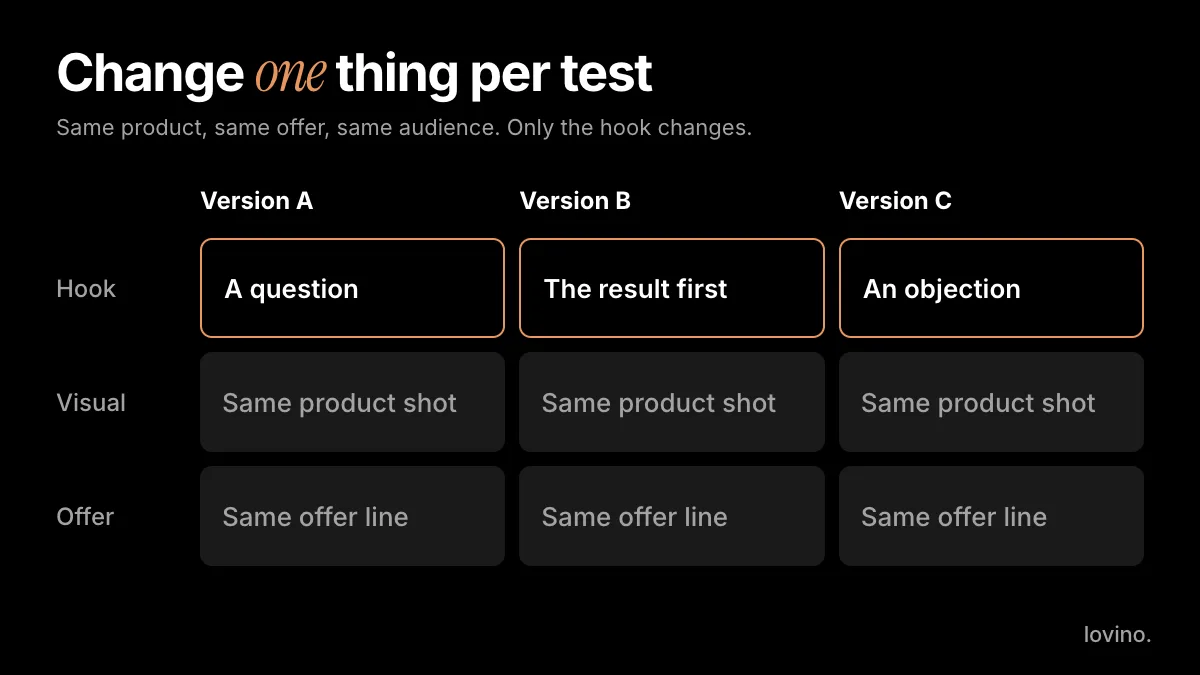
SERUM_hook-question_scene-flatlay_offer-intro_v1
SERUM_hook-result_scene-flatlay_offer-intro_v1
SERUM_hook-objection_scene-flatlay_offer-intro_v1
Only one segment differs, so the name tells you what the test was.
How do you make the variants quickly?
Use AI for the parts that are slow and keep your judgement for the parts that are risky.
Hooks. Ask for options, then choose. A prompt you can paste into an AI chat assistant:
Write three first lines for a 6-second ad for an unbranded amber serum bottle.
One as a question, one that opens on the result, one that answers a common objection.
Six words or fewer each. No claims about results or ingredients.
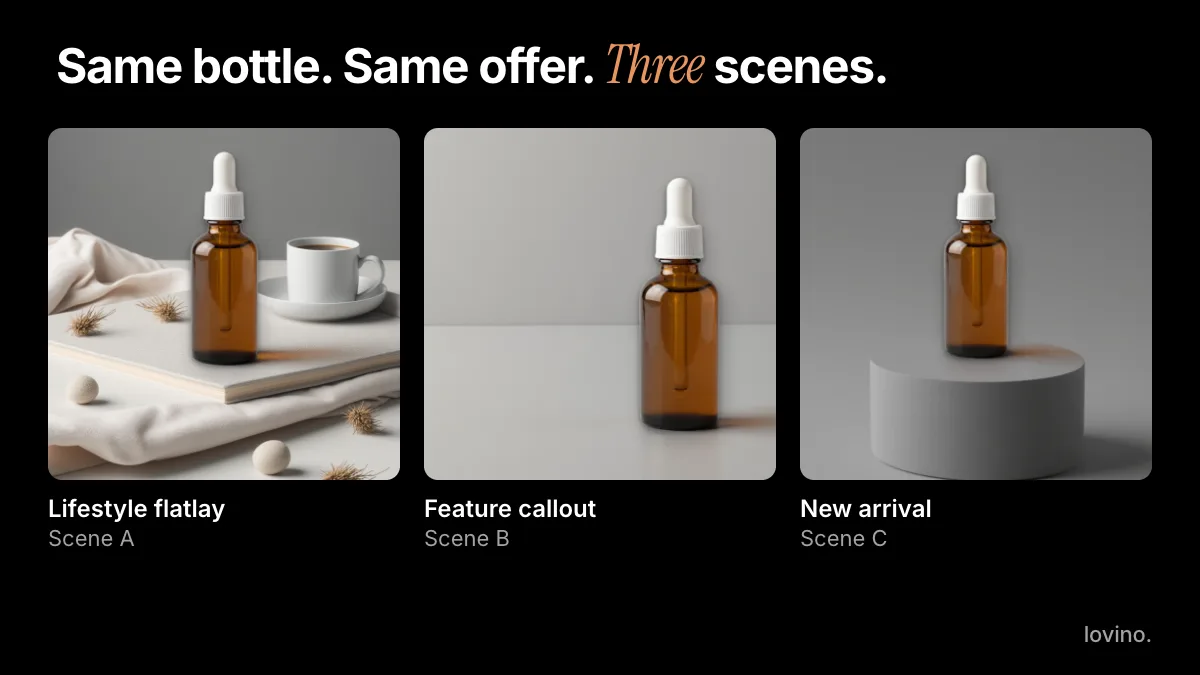
Scenes. One product photo can become several ad scenes in Ad Studio. These three come from the same bottle: Lifestyle Flatlay, Feature Callout and New Arrival. The product pixels stay the same, but each recipe also drafts its own headline and sets its own layout. Edit the copy so all three versions say the same thing, or you are testing three changes at once. Each scene uses paid credits, and the copy draft is free.
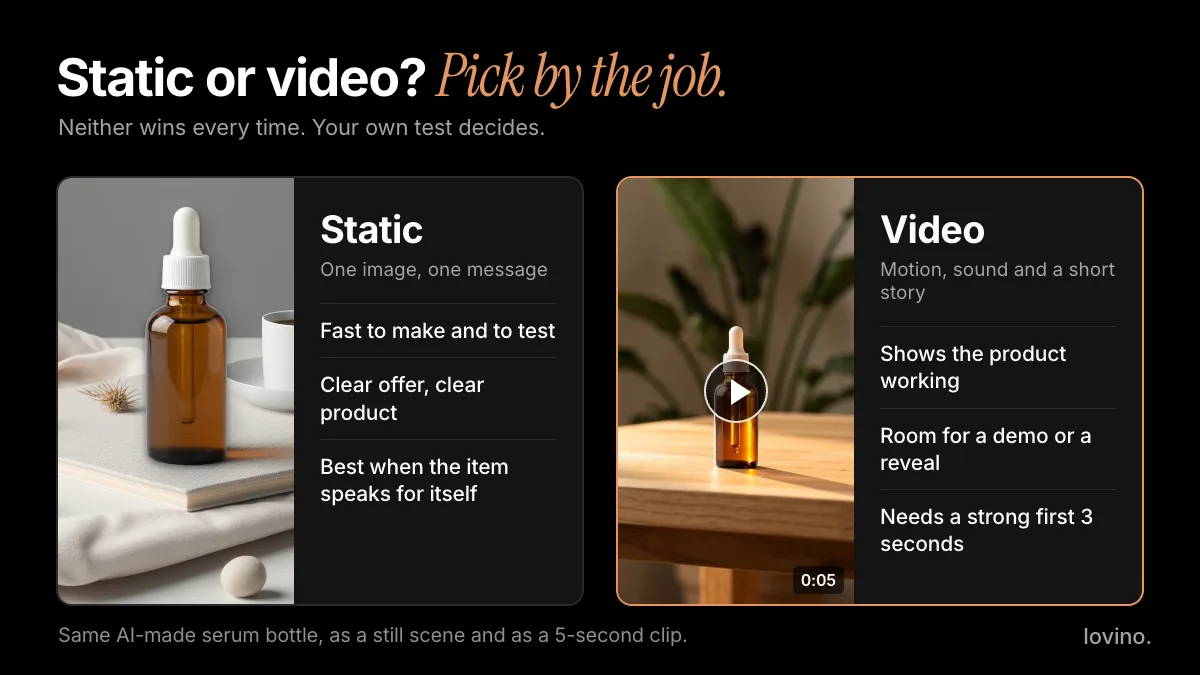
Format. Once an image wins, make it a video and test static against video in the next round. In Ad Studio, a video needs a paid plan and the credit cost is shown before you generate. See pricing for credits. The trade-offs between the two formats are in static vs video ads.
What does a worked example look like?
Say you sell one serum and want better ads. Three rounds could look like this:
- Round 1, hook. Same bottle, same scene, same offer. Three hooks: a question, the result first, an objection. Keep the winner.
- Round 2, scene. The winning hook on three scenes (flatlay, feature callout, new arrival), with the same headline on each. Keep the winner.
- Round 3, format. The winning image next to a short clip of it. Now you know which hook, scene and format work together, and why.
Each round takes a handful of versions, not thirty. By the end you have a concept you understand, not a lucky ad you cannot repeat.
What should you measure?
Pick the metric that matches the job, and read the funnel in order: do people stop, do they watch, do they click, do they buy. Each platform names these differently, so use the platform's own labels.
There is no universal good number. Compare your versions with each other and with your own past ads.
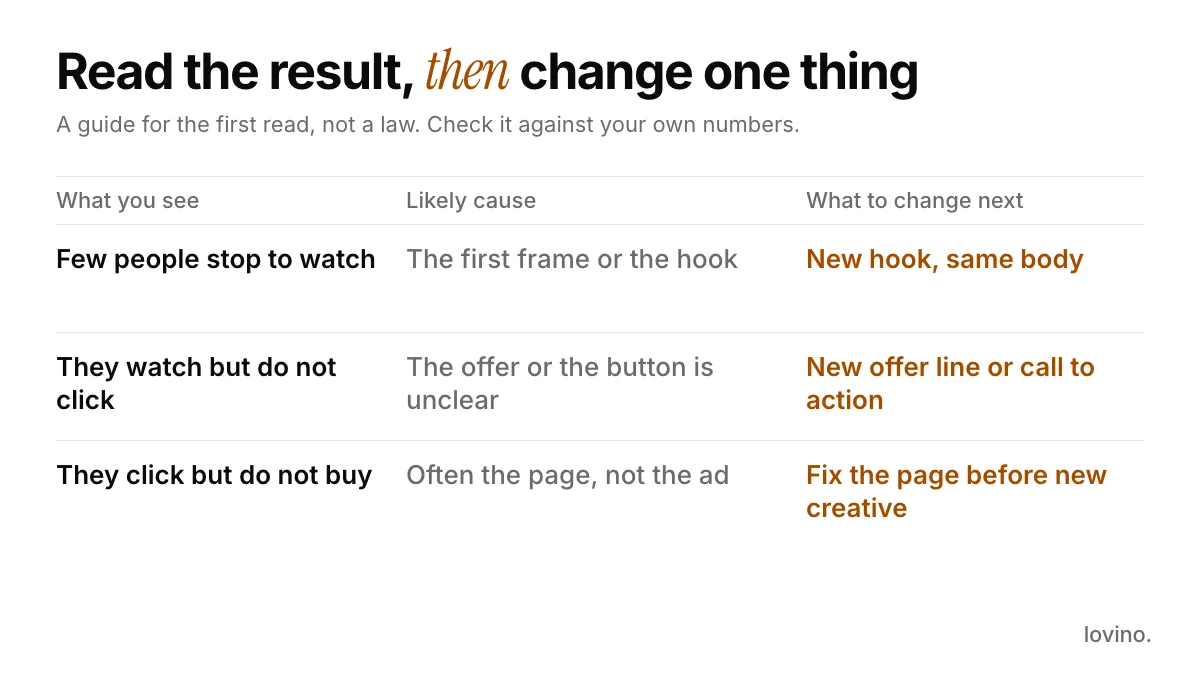
Be careful with the last row. If people click and do not buy, the ad has often done its job. New creative will not fix a weak landing page.
How long should a test run, and how much do you need to spend?
There is no fixed rule, but Meta gives one useful anchor. It says an ad set usually exits the learning phase after about 50 results in the week after its last significant edit. If your budget cannot reach that on purchases, test against an earlier step such as link clicks, and treat the answer as a clue rather than proof.
Do not call a winner on day one. Do not keep a test running for weeks because you like one version either.
What should you never fake in a test?
Fast tools make shortcuts tempting. Keep these lines clear:
- Quotes and reviews. The Customer Quote and Social Proof recipes are layouts. Use them only with real words from real customers and real numbers you can show.
- The product. AI should style and present what you sell. It must not make the product look better than it is, or show features it lacks.
- People. An AI-made person is fine as a presenter. Do not pass one off as a real customer.
- Results. A before-and-after must show a real before and a real after.
- Disclosure. Some places require AI labels on ads. See AI content disclosure.
A test that rests on invented proof only tells you which lie sells best.
Start small
Pick one product and one question. Make three versions that differ in one layer, name them clearly, launch with equal budgets, and write your hypothesis down first. Then make the winner your control and ask the next question.
To make the first set, open Lovino's AI ad generator with one clean product photo. If the hooks are the layer you want to test, read the video ad hooks guide first. Check each placement against the video ad specs before you launch.
Questions, answered.
How many ad creatives should I test at once?
Two to four versions of one idea, changing one layer. Meta's help pages warn that creating many ads and ad sets means the delivery system learns less about each one, so a long list of variants spreads your budget too thin to read.
What should I test first in ad creative?
The hook and the first frame. They decide whether anyone keeps watching, so every later choice depends on them. After that, test the scene, then the offer line, then the call to action.
How long should an ad creative test run?
Until each version has enough results to compare. Meta says an ad set usually leaves the learning phase after about 50 results in the week following its last significant edit. Avoid editing the ads mid-test, and do not decide on the first day.
Can AI make ad variations for testing?
Yes. AI can draft hook lines, build different scenes around one product photo and turn an image into a short video. You still choose what to launch and check every claim, price and quote. In Lovino's Ad Studio, scenes use paid credits and video needs a paid plan; see the pricing page.