Static vs Video Ads (2026): Which One for Your Product?
Static vs video ads: when each one wins, how to decide for your own product, and how to make both with AI without faking the product or the proof.
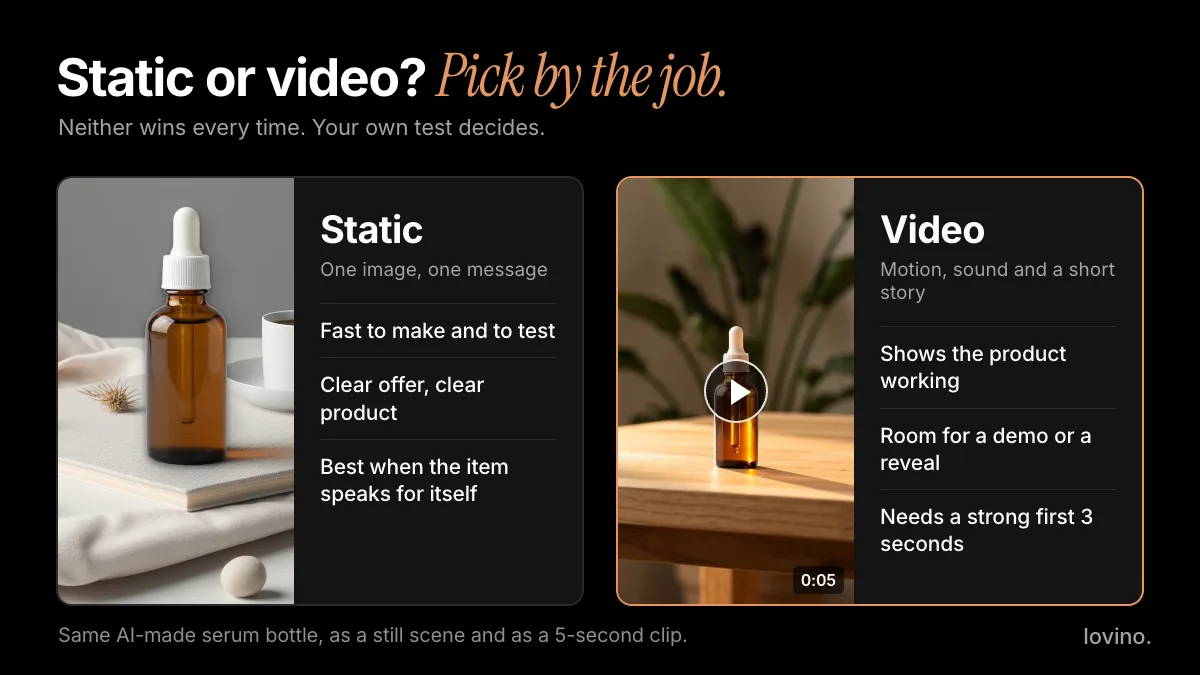
Static vs video ads has no universal winner. A static ad wins when the product explains itself at a glance and you want cheap, fast tests. A video ad wins when the buyer needs to see the product move, work or be used. If you are not sure, start static, find the idea that works, then spend video effort on that idea.
The rest of this post gives you rules of thumb for choosing between image ads and video ads, a way to make both from one photo, and the lines you should not cross with either. None of it replaces a test in your own account, but it will stop you spending video money on an idea that has not earned it.
Static vs video ads: what is the real difference?
A static ad is judged in a glance. A video ad is judged in its first few seconds. That one gap explains most of the trade-offs.
| Question | Static ad | Video ad |
|---|---|---|
| What does it do best? | One clear picture and one message | Shows motion, use, a reveal or a short story |
| How fast is it to make? | Quick to make, quick to review | Slower to make, and you must watch the whole clip |
| What does it cost to make with AI? | Usually fewer credits per version | Usually more credits per version |
| How is it judged? | At a glance, in the feed | In the first seconds, then by what follows |
| Where does it fail? | Blends into the scroll | Loses the viewer before the point |
| Good first test? | Several angles on one product | One proven angle, in motion |
The credit line describes how Lovino works today. Check pricing for current numbers.
When do static ads win?
Pick static when one of these is true:
- The product has a clear shape. A sneaker, a bottle, a watch. People understand it without motion.
- The message is the offer. A sale, a bundle, a new arrival, a date. Words and a clean product shot do the job.
- You need many angles quickly. Static is the cheapest way to try five ideas before you commit to one.
- Your budget is small. Fewer variables to produce, fewer files to review, and fewer ways to go wrong.
- You are building a base of proven ideas. A static winner is a tested concept you can later animate.
When do video ads win?
Pick video when the buyer needs to understand something a still cannot show:
- The product needs a demonstration. How a serum drops, how a bag opens, how a gadget is used.
- There is a process or a reveal. An unboxing, a before-and-after, a routine in three steps.
- A person or a voice sells it. A founder story, a real explanation, a spoken tip.
- Sound carries meaning. A pour, a click, a short line of speech. Video is the only one of the two that has it.
Ad Studio's video recipes follow these patterns: Unboxing Reveal, Founder Story, Step-by-Step Routine and Three Reasons Why, among others.
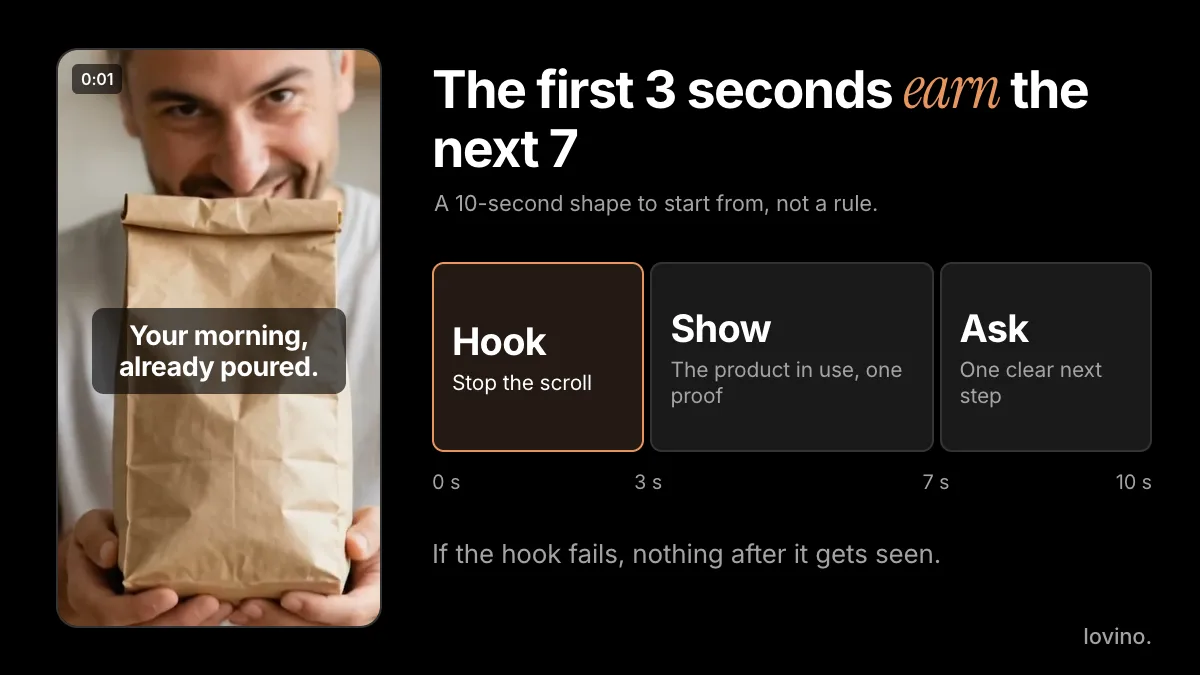
Video has a stricter clock. On YouTube, for example, Google's help page says a viewer can skip a skippable in-stream ad after 5 seconds. Whatever you show first has to earn the rest. The video ad hooks guide goes through how.
How do you decide for your product?
Ask three questions in order.
- Does the buyer need to see it work? If no, start static. If yes, start video.
- Can you show it honestly? If the clip would need features, results or reactions that are not real, make a static ad instead.
- How many ideas do you need to test? More than three ideas means static first. Then animate the one that wins.

Here is how that plays out for a few products. These are rules of thumb, not data.
| Product | Start with | Why |
|---|---|---|
| A plain white sneaker | Static | The shape sells, and you can try several angles fast |
| A face serum | Static, then video | A clean pack shot first, then a clip of the dropper and the texture |
| A backpack | Video | Opening, pockets and carrying are the point |
| A mug sale | Static | The offer is the message |
| A kitchen gadget | Video | Seeing it work is the whole pitch |
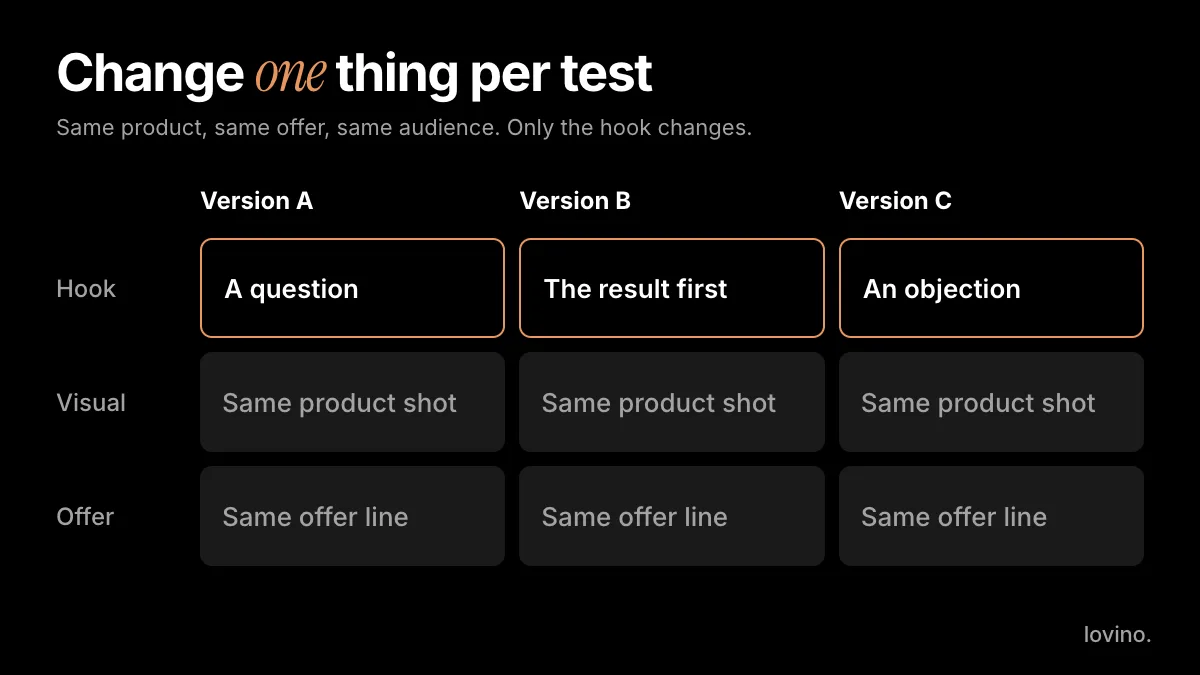
Do not decide on taste. Decide with a small test. The one-variable testing method works for format too. Keep the hook, offer and product identical, and change only static versus video.
How do you make both with AI?
You can make both from one product photo on Lovino.
- Start with the photo. One sharp shot, whole product in frame, plain background.
- Make the static ad. In Ad Studio, pick a recipe. Lovino keeps your product as photographed, builds a new scene around it and drafts a headline, subhead and button text. Choose a square, vertical or wide format and download a PNG.
- Make the video. Use "Make it a video" on the same ad, or take the image into the image-to-video tool and write your own motion prompt. In Ad Studio, video needs a paid plan and the credit cost is shown before you generate.
- Check the format for each placement. The video ad specs post lists ratios, lengths and file limits.
Here is one bottle both ways: a static Lifestyle Flatlay scene, then a 5-second clip that "Make it a video" built from the same product photo.

If you animate a still yourself in the image-to-video tool, keep the prompt about this short:
Slow pull-back from a close-up of the bottle to a wider shot of the table.
Warm morning light, soft focus on the plant behind. Keep the label and shape unchanged.
What should you never fake in either format?
- The product. AI should style the scene, not redesign the item. For video, watch the whole clip. Models can invent motion, and a label, cap or button can drift between frames. If it changed, regenerate.
- Results. Do not show a before-and-after that never happened.
- Reactions and reviews. A video of a smiling customer is a claim. Do not use an AI-made person as a real buyer.
- Claims and prices. AI-written copy is a draft. Check every line before it runs.
- Labels. Some places ask for AI disclosure on ads. See AI content disclosure.
What are the common mistakes?
- A video that is a static ad with a zoom. If nothing in it moves for a reason, make the static ad and save the credits.
- Changing everything at once. If the video also has a new hook and offer, you have tested nothing about format.
- Forgetting sound-off. Some people watch muted. Put the point in the picture and in on-screen words, then add sound.
- Judging too early. One day of data tells you little about either format.
Start with one photo
Make a static ad first. If the product needs motion, animate the best one. Run the two against each other with everything else held the same, and let your own numbers choose.
To try it, open Lovino's AI ad generator with one clean product photo. It writes the copy draft for free. Scenes use paid credits, and a video needs a paid plan.
Questions, answered.
Do video ads perform better than static ads?
Not always. It depends on the product, the offer, the audience and how good the creative is. A static ad can beat a weak video, and the reverse. The only reliable answer comes from testing both in your own account with everything but the format held the same.
Are static ads cheaper to make than video ads?
Usually, yes. A still is quicker to make and review, and on Lovino images generally use fewer credits than video. Ad Studio video needs a paid plan, and its credit cost is shown before you generate. See the pricing page for current numbers.
Can I turn a static ad into a video with AI?
Yes. In Ad Studio, the Make it a video step turns an ad into a short vertical clip. You can also take the image into an image-to-video tool, write a one-line motion prompt and choose a model. Watch the full clip before you use it, because AI can change small details.
Which should a small business make first, static or video?
Static, in most cases. It is faster and cheaper to test several angles. Once one angle clearly works, turn it into a video if the product benefits from motion.