Flux vs DALL-E 3 vs Stable Diffusion: Which Is Best in 2026?
A direct comparison of the three leading AI image generation models — Flux, DALL-E 3, and Stable Diffusion. Strengths, weaknesses, and which to use when.

Three models dominate AI image generation in 2026, each with distinct strengths, limitations, and optimal use cases. Choosing between them isn't a matter of one being simply "better" — it's about matching the model's strengths to your specific needs. Here's the full comparison.
| Category | Winner | Why |
|---|---|---|
| Photorealism | Flux Pro | Skin, materials and lighting look most photographic |
| Text inside images | DALL-E 3 (of these three) | Best spelling; OpenAI's newer GPT Image 2 now leads overall |
| Prompt adherence | DALL-E 3 | Follows specific layouts and relationships closely |
| Customization and control | Stable Diffusion | Fine-tunes, LoRAs, ControlNet, local use |
| Ease of use | DALL-E 3 (via ChatGPT) | Describe it in plain language |
For a wider view of the model landscape, see the state of AI image generation in 2026 and What Is Flux?.
Quick Overview
Flux (Black Forest Labs): Best for photorealism and general-purpose generation. Industry-leading for highly realistic photograph generation.
DALL-E 3 (OpenAI): Best for text rendering within images and ChatGPT integration. Strong semantic understanding of complex prompts.
Stable Diffusion (Stability AI + community): Best for open-source customization, fine-tuning, local deployment, and the largest ecosystem of community models.
Photorealism
Winner: Flux Pro
Flux Pro sets the current benchmark for photorealistic generation. At standard web display sizes, Flux-generated images of people, landscapes, and products are comparable to professional photography. The model handles skin textures, material rendering, lighting behavior, and compositional coherence better than any currently available alternative.
DALL-E 3 is strong but slightly behind Flux in pure photorealism for images of people — it tends toward a slightly cleaner, slightly "rendered" aesthetic rather than true photographic naturalism.
Stable Diffusion SDXL is capable of photorealism with the right fine-tunes and settings, but requires more technical knowledge and iteration to achieve results comparable to Flux Pro's defaults.
Here are two FLUX 1.1 Pro outputs from Lovino, with the exact prompts. Different prompts, so read them as a look at style.
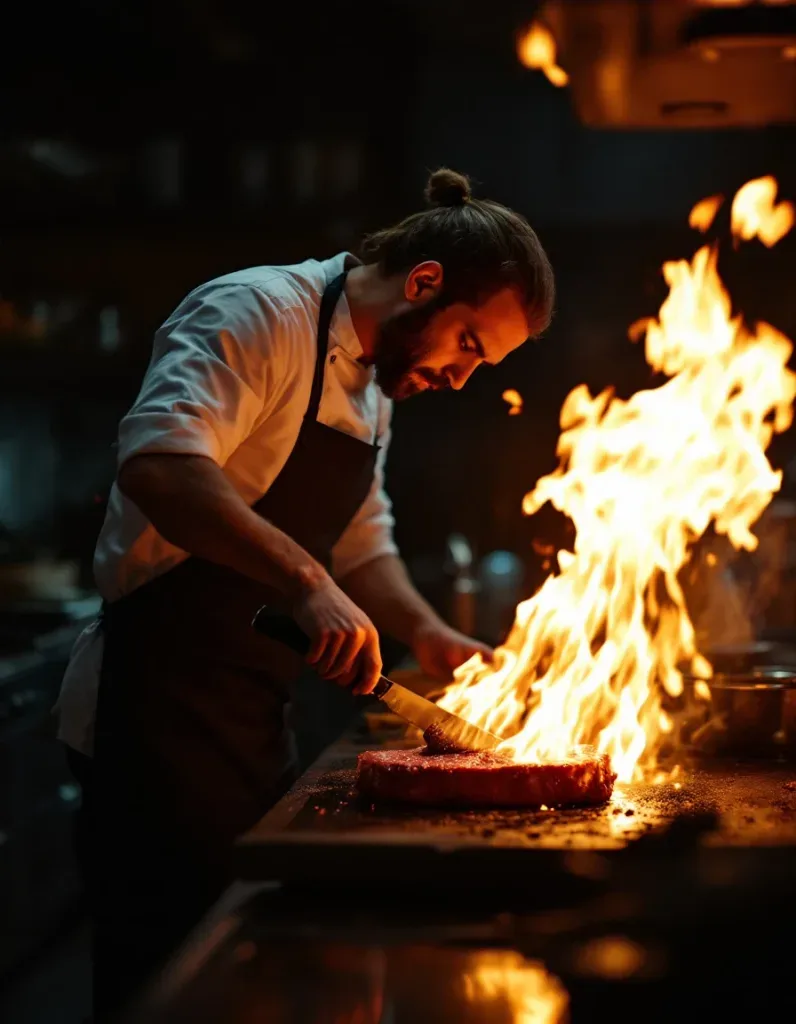
Prompt used: "Chef searing a steak with dramatic flame burst in a dark professional kitchen, cinematic warm-neutral color grade, soft directional key light, 35mm lens, shallow depth of field, natural skin tones, subtle film grain" — generated with FLUX 1.1 Pro on Lovino.

Prompt used: "Mountain observatory under the Milky Way, dome open, warm interior light, cinematic warm-neutral color grade, soft directional key light, 35mm lens, shallow depth of field, natural skin tones, subtle film grain" — generated with FLUX 1.1 Pro on Lovino.
Text Rendering in Images
Winner (of these three): DALL-E 3
Generating images with readable text inside them (signs, labels, posters, book covers) remains challenging for most models. Of the three models compared here, DALL-E 3 handles this best — producing accurately spelled, naturally rendered text within images. Flux has improved significantly but still occasionally misspells or distorts text. Stable Diffusion base models struggle significantly with text.
If your use case requires images with correctly spelled words, DALL-E 3 leads this trio — though OpenAI's newer GPT Image 2 has since taken the overall text-rendering crown. Here is GPT Image 2 on Lovino, for comparison:
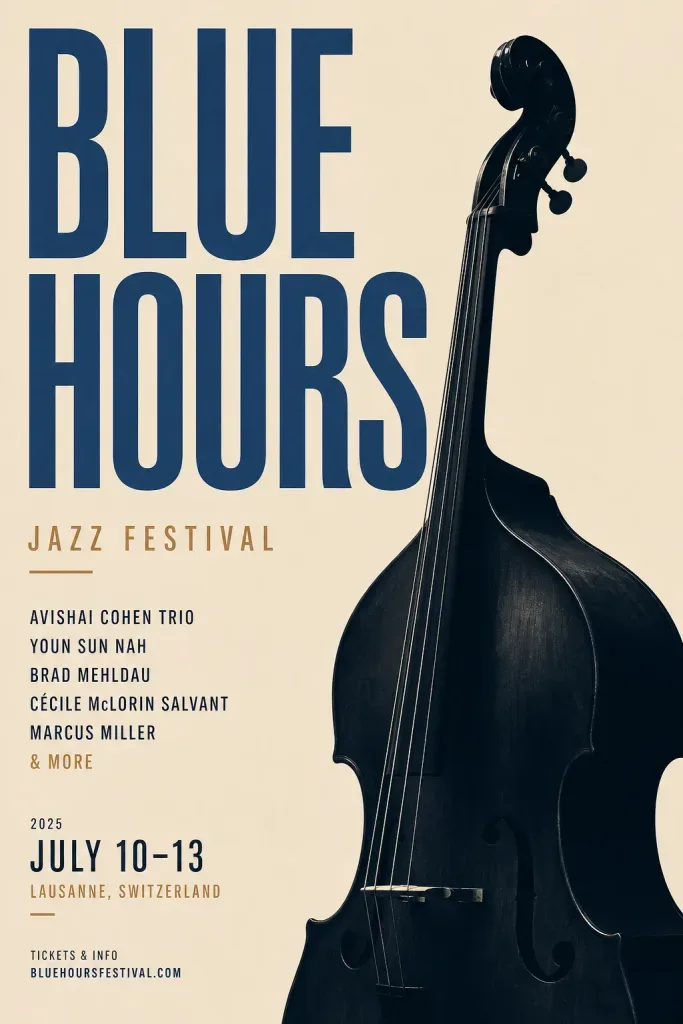
Prompt used: "Minimal Swiss-style poster for a jazz festival titled 'BLUE HOURS', bold typography and a double bass silhouette, warm-neutral palette, soft diffused lighting, cohesive minimal background, premium editorial composition" — generated with GPT Image 2 on Lovino.
See GPT Image 2 vs Flux for the head-to-head.
Prompt Adherence
Winner: DALL-E 3 (nuanced)
DALL-E 3 follows complex, detailed prompts with strong semantic accuracy — if you describe a specific layout, specific objects in specific positions, and specific relationships between elements, DALL-E 3 tends to interpret this more precisely.
Flux shows excellent prompt adherence for visual and atmospheric prompts. Where it can fall behind DALL-E is in very specific compositional instructions.
Stable Diffusion's prompt adherence varies significantly by model and requires more prompt engineering knowledge.
Customization and Control
Winner: Stable Diffusion
This is Stable Diffusion's undisputed domain. The community ecosystem around SD includes thousands of fine-tuned models (specialized for specific styles, subjects, people, and aesthetics), LoRA adapters for consistent characters, ControlNet for precise compositional control, and dozens of community extensions.
For users who need complete control — specific consistent characters, precise pose control, custom style fine-tuning, on-premises deployment — Stable Diffusion's ecosystem is unmatched.
Flux has a growing ecosystem of fine-tunes, but it's early-stage compared to SD's years of community development.
DALL-E 3 offers no fine-tuning or community model ecosystem. You use it as-is.
Ease of Use
Winner: DALL-E 3 (via ChatGPT)
DALL-E 3's integration with ChatGPT makes it the most accessible model for non-technical users. Describe what you want conversationally, iterate through feedback, and receive the result — no settings, no prompt engineering required.
Lovino.ai and similar platforms provide comparable ease-of-use for Flux, with a clean interface that produces great results from simple descriptions.
Stable Diffusion's full capability requires technical comfort — running local tools (Automatic1111, ComfyUI) or navigating more complex interfaces.
Cost
Comparison (approximate):
- Flux on Lovino: FLUX Fast and FLUX Dev run on the free daily credits (3 a day); FLUX 1.1 Pro and FLUX 2 Pro need a paid plan (see the pricing page)
- DALL-E 3 via ChatGPT: ChatGPT free (limited), paid ChatGPT plans (expanded), API pricing per image
- Stable Diffusion local: Free to run on own hardware; free cloud options available; commercial SD services vary
When to Use Each
Use Flux (via Lovino.ai) when:
- Photorealism is the priority
- You want great results without extensive prompt engineering
- You need integrated creative tools (face swap, travel selfies, portraits, and video on paid credits)
- You want a free daily tier for everyday images (see our best free AI image generators)
Use DALL-E 3 (via ChatGPT) when:
- You need text rendered within images
- You want conversational image iteration
- You're already in the ChatGPT ecosystem
Use Stable Diffusion when:
- You need complete customization and control
- You're fine-tuning on specific characters or styles
- You need local/on-premises deployment
- You want the broadest community model ecosystem
Pricing details in this post reflect each provider's published information as of April 2026 and may change — verify current pricing on each provider's site.
Try FLUX on Lovino — free daily credits cover FLUX Fast and FLUX Dev, and FLUX 1.1 Pro needs a paid plan. No technical setup required.
Questions, answered.
Is Flux better than DALL-E 3 for AI image generation?
Flux Pro is better for photorealism. DALL-E 3 is better for text rendering within images and conversational iteration via ChatGPT. For most photographic use cases (portraits, landscapes, products), Flux produces more convincingly realistic results.
What is Stable Diffusion best for?
Stable Diffusion excels at customization: fine-tuning on specific characters or styles, ControlNet for precise compositional control, local/on-premises deployment, and accessing the largest community ecosystem of specialized models. It requires more technical knowledge than Flux or DALL-E.
Which AI model is best for text in images?
Of the three models compared here, DALL-E 3 leads for generating images with accurately spelled, naturally rendered text. Overall, OpenAI's newer GPT Image 2 is now the strongest option for text-heavy images.
Which AI image model is free?
All three have free access options. Lovino.ai (Flux) offers 3 free daily credits with daily refresh. DALL-E 3 is accessible through the free ChatGPT tier with limited usage. Stable Diffusion is free to run locally on compatible hardware.