Creating stunning travel photos with AI starts with understanding how to craft the perfect prompt. A great prompt is part art direction, part storytelling — it tells the AI exactly what mood, lighting, and composition you're after. In this guide, we'll walk through 10 proven prompt templates that consistently produce professional-quality results, and explain the principles behind each one so you can adapt them to any destination.
| # | Template | Best for | Key phrase |
|---|---|---|---|
| 1 | Cinematic Sunset | Landmarks, skylines | golden hour, cinematic lighting |
| 2 | Aerial Perspective | Terraces, coastlines, landscapes | bird's eye perspective, morning mist |
| 3 | Luxury Escape | Resorts, pools, villas | premium resort aesthetic |
| 4 | Street Scene | Cities, markets, nightlife | documentary style photography |
| 5 | Minimalist Editorial | Architecture, design-led shots | negative space, editorial magazine style |
| 6 | Night Sky | Aurora, stars, dark landscapes | long exposure night photography |
| 7 | Wildlife at Golden Hour | Safari and nature | silhouetted against the sunset |
| 8 | Cozy Winter Escape | Cabins, snowy villages | warm light from the windows |
| 9 | Ancient Wonder at Dawn | Ruins and heritage sites | mist rolling through, golden morning light |
| 10 | Market Immersion | Souks, food markets | warm ambient light, street photography |
1. The Cinematic Sunset
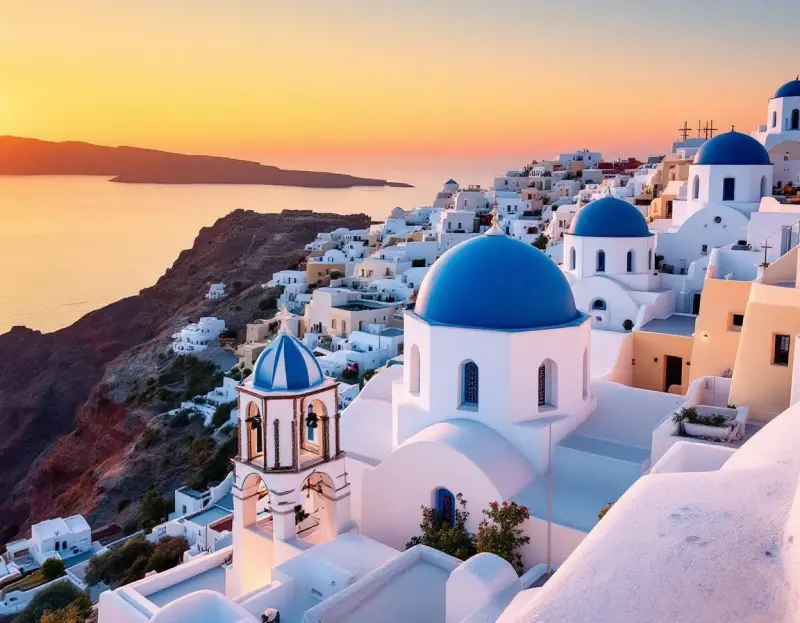
Few techniques elevate a travel image faster than golden-hour lighting. The warm, directional light naturally adds depth and drama, while long shadows create a sense of place and time.
[Location] at golden hour, cinematic lighting, warm orange and pink sky, silhouetted [subject], professional travel photography, 8K quality
For example, try "Santorini at golden hour, cinematic lighting, warm orange and pink sky, silhouetted church domes, professional travel photography, 8K quality". This prompt succeeds because it layers multiple signals together: a specific location anchors the scene, "golden hour" and "cinematic" set the mood, the color palette guides the palette, and "8K quality" pushes the output toward sharper detail. Each element reinforces the others, giving the AI a clear creative direction instead of vague instructions. Light is the biggest lever of all, so our guide to mastering lighting in AI travel prompts is worth a read next.
2. The Aerial Perspective
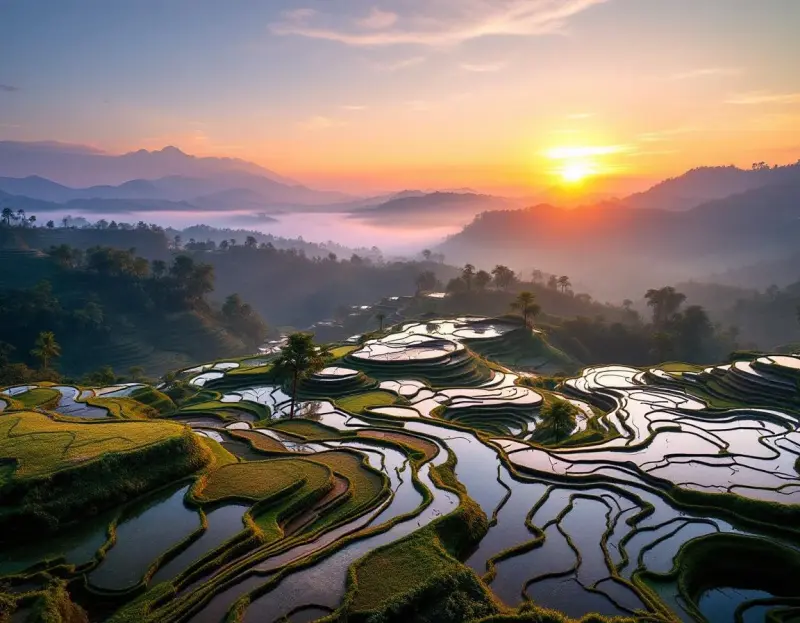
Aerial views immediately communicate scale and reveal patterns invisible from the ground — the geometry of rice terraces, the curve of a coastline, the grid of a city. Adding atmospheric effects like morning mist creates separation between layers and gives the image a sense of depth that feels almost three-dimensional.
Drone aerial view of [location], bird's eye perspective, [specific feature], morning mist, dramatic landscape photography
A prompt like "Drone aerial view of Bali rice terraces, bird's eye perspective, geometric patterns, morning mist, dramatic landscape photography" works well because the phrase "bird's eye perspective" establishes the camera angle, while "geometric patterns" tells the AI what visual element to emphasize. Experiment with different altitudes — "overhead directly above" gives a flat, graphic look, while "angled drone view at 45 degrees" preserves more depth. For a location-by-location example, see Best Bali Photo Spots for AI Travel Image Generation.
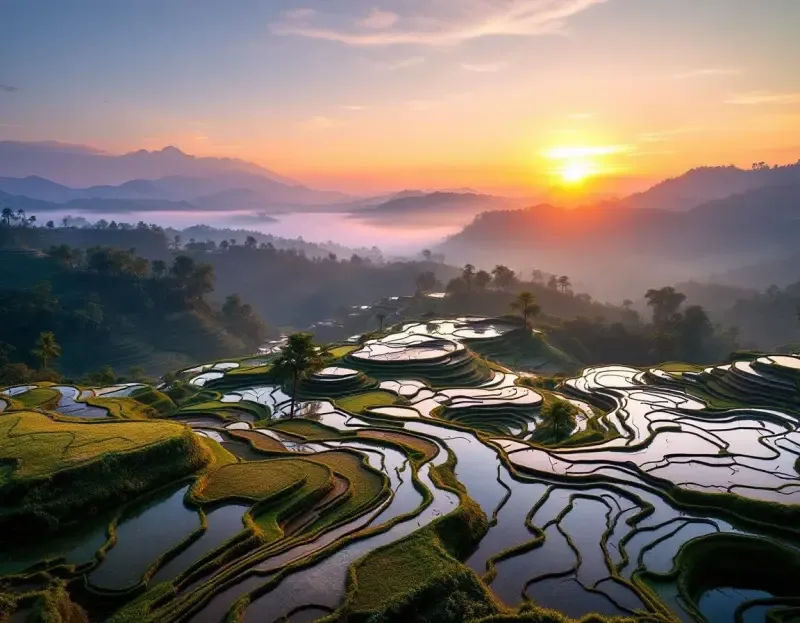
Prompt used: "Tegallalang rice terraces at sunrise with morning mist rolling through, lush green paddy fields, dramatic light rays through palm trees, drone aerial photography, National Geographic style" — generated with AI for the Lovino destination gallery.
3. The Luxury Escape
Luxury travel imagery relies on a sense of aspiration: pristine surfaces, soft natural light, and a view that feels exclusive. The key is restraint — these images work best when they feel effortlessly polished rather than overproduced.
[Luxury setting] with [view], premium resort aesthetic, pristine and polished, soft natural lighting, lifestyle photography
"Infinity pool overlooking the ocean, premium resort aesthetic, pristine and polished, soft natural lighting, lifestyle photography" — notice how "lifestyle photography" signals a relaxed, editorial feel rather than a real-estate listing. For best results, keep the composition simple and let one hero element (the pool, the view, the suite) do the heavy lifting.
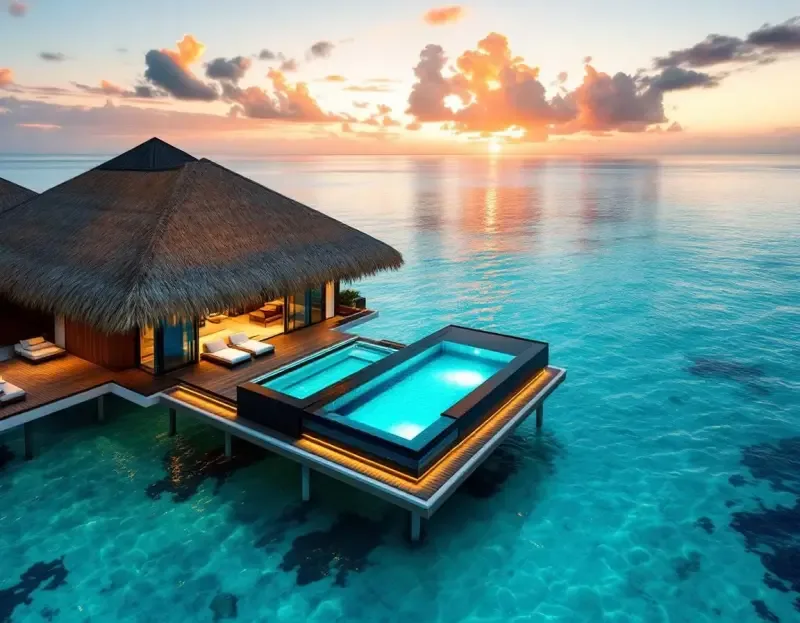
Prompt used: "Luxurious overwater villa in the Maldives at golden hour, crystal clear turquoise lagoon, thatched roof bungalow with private infinity pool, bioluminescent water reflections, drone aerial view, ultra-realistic travel photography, 8k resolution" — generated with AI for the Lovino destination gallery.
4. The Street Scene
Street photography thrives on authenticity and energy. The best street-level prompts capture a specific moment rather than a generic scene — wet pavement reflecting neon, a vendor preparing food, pedestrians caught mid-stride.
[City] street scene at [time], authentic local atmosphere, [activity], vibrant colors, documentary style photography
Try "Tokyo street scene at night, authentic local atmosphere, neon signs reflecting on wet pavement, vibrant colors, documentary style photography". The phrase "documentary style" is crucial here — it signals candid, unposed compositions with natural imperfections that make the image feel real. Specifying the time of day (night, blue hour, midday) dramatically changes the mood and color palette of the result.
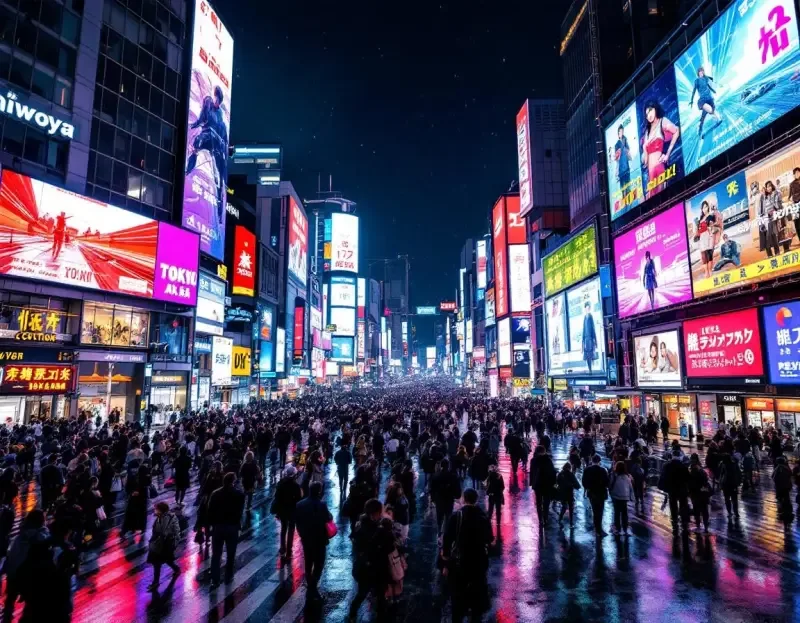
Prompt used: "Shibuya Crossing in Tokyo at night, neon lights reflecting on wet streets, massive LED billboards, bustling crowd with umbrellas, cyberpunk aesthetic, cinematic street photography" — generated with AI for the Lovino destination gallery.
5. The Minimalist Editorial
Sometimes the most powerful travel images are the simplest. Minimalist compositions use negative space, geometric shapes, and limited color palettes to create images that feel sophisticated and magazine-ready.
[Subject] in [location], clean minimal composition, negative space, soft shadows, editorial magazine style
"White architecture in Mykonos, clean minimal composition, negative space, soft shadows, editorial magazine style" produces the kind of image you'd see in Condé Nast Traveler. The trick is to pair a strong subject with plenty of breathing room — the negative space is what gives the image its editorial quality.
6. The Night Sky
Darkness gives travel images drama that daylight can't match. Aurora, star fields and long exposures work best when the prompt says outright that this is a night shot, with a bright sky over a dark foreground.
[Landscape] under [aurora borealis or Milky Way], vibrant [colors] sky, [foreground detail], long exposure night photography
"Long exposure night photography" is the phrase doing the work here. It pushes the sky toward the smooth, saturated look of a real long exposure instead of a flat night scene.
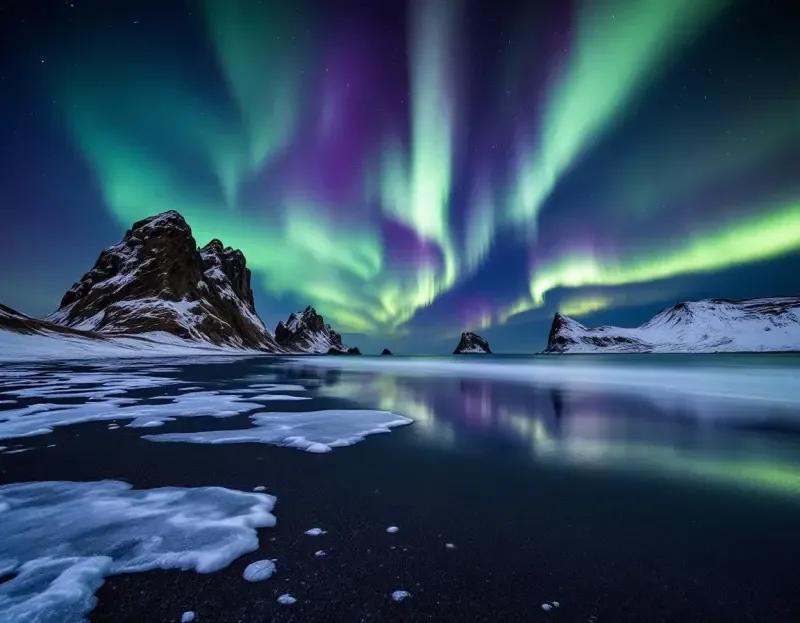
Prompt used: "Northern lights aurora borealis dancing over Iceland's black sand beach, vibrant green and purple sky, dramatic ice formations, long exposure night photography" — generated with AI for the Lovino destination gallery.
7. Wildlife at Golden Hour
Animals read best as silhouettes against a big sky. Give the AI the habitat and the light, and keep the subject count low so each animal stays clear. For a full walkthrough, see AI Safari Photography.
[Animal] silhouetted against a dramatic [sunset] sky, [habitat], sweeping landscape, golden hour, wildlife photography
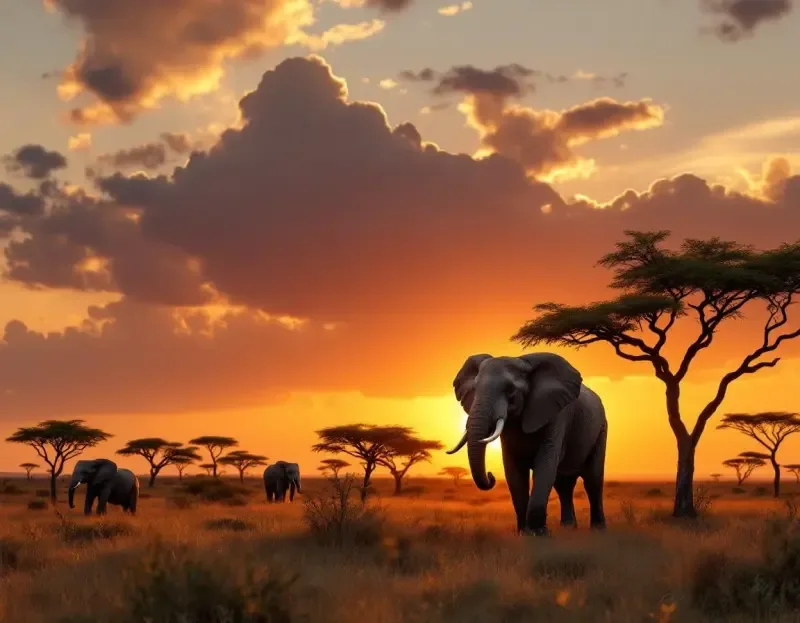
Prompt used: "African safari in Masai Mara at golden hour, elephants silhouetted against dramatic sunset sky, acacia trees, sweeping savanna landscape, National Geographic wildlife photography" — generated with AI for the Lovino destination gallery.
8. The Cozy Winter Escape
Warm windows against cold snow are a reliable mood. Name the warm light source and the cold surroundings, and the contrast does the rest.
[Cabin or village] in [snowy location], fresh snow, warm golden light from the windows, [mountain backdrop], starry night sky
A real example: "Cozy wooden mountain cabin in the Swiss Alps with Matterhorn peak backdrop, fresh snow covering the landscape, warm golden light from windows, starry night sky, magical winter wonderland atmosphere".
9. The Ancient Wonder at Dawn
Heritage sites look their best when weather does something interesting. Ask for mist, cloud or low sun, and name the mountain or skyline that frames the site.
[Ancient site] at dawn, clouds and mist rolling through, [mountain backdrop], golden morning light, epic landscape photography
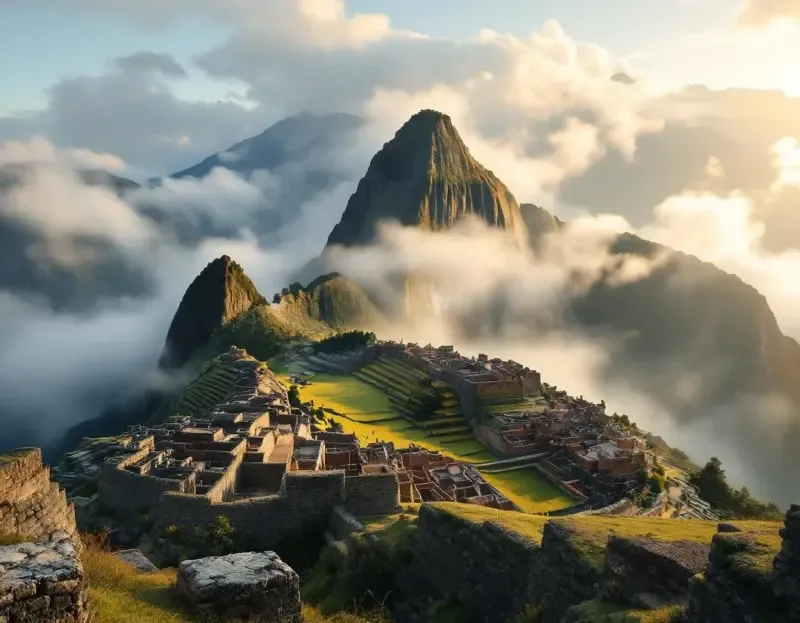
Prompt used: "Machu Picchu at dawn with dramatic clouds and mist rolling through ancient ruins, Huayna Picchu mountain backdrop, golden morning light, epic landscape photography" — generated with AI for the Lovino destination gallery.
10. The Market Immersion
Markets are full of color, texture and people, which makes them hard to describe in a few words. Lead with the place, then list two or three textures and finish with the light.
[Market or souk] in [city], colorful [goods], intricate [local] architecture, warm ambient light, street photography
A real example: "Vibrant Marrakech souk marketplace, colorful spices and textiles, intricate Moroccan architecture, warm ambient light, street photography, cultural travel aesthetic".
Pro Tips for Better Prompts
Across all ten templates, four principles make the biggest difference:
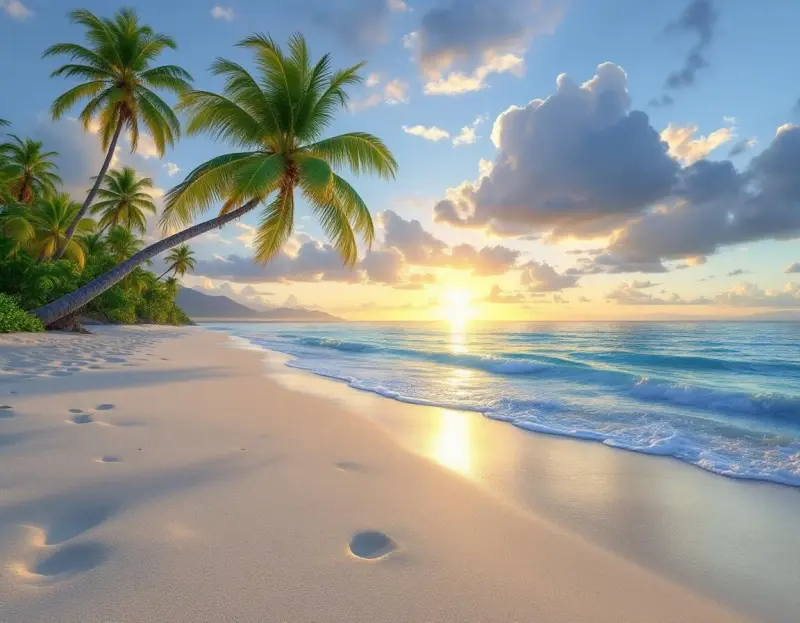
Be specific about the scene. Instead of "a beautiful beach," describe which beach, what's in the foreground, and what the light looks like. Specificity gives the AI something concrete to work with and dramatically reduces the randomness of results.
Include a style reference. Words like "cinematic," "editorial," "documentary," or "fine art" act as shorthand for an entire aesthetic — camera angle, color grading, composition style. One well-chosen style word can transform an ordinary prompt.
Set the emotional tone through light and color. "Warm golden light" produces a completely different feeling than "cool blue twilight." Think about what emotion you want the viewer to feel, then choose your lighting and color words to match.
Add quality indicators at the end. Phrases like "8K quality," "professional photography," or "high resolution" don't change the subject matter, but they push the output toward cleaner detail and more polished rendering. Think of them as a finishing touch.
Conclusion
These templates are starting points, not rigid formulas. The most effective creators combine elements from different templates — the lighting approach from a cinematic sunset with the composition of a minimalist editorial, for instance. Over time, you'll develop an instinct for which combination of words reliably produces the look you're after.
The best prompts share three qualities: they're specific about the scene, clear about the mood, and intentional about the style. Master those three dimensions, and you'll consistently produce images that look professionally shot.
Ready to try these prompts? Paste one into the AI image generator. A free Lovino account includes 3 credits a day. New to prompting? Start with A Beginner's Guide to AI Travel Photography, or put yourself in the picture with Travel Selfies.